
 By martin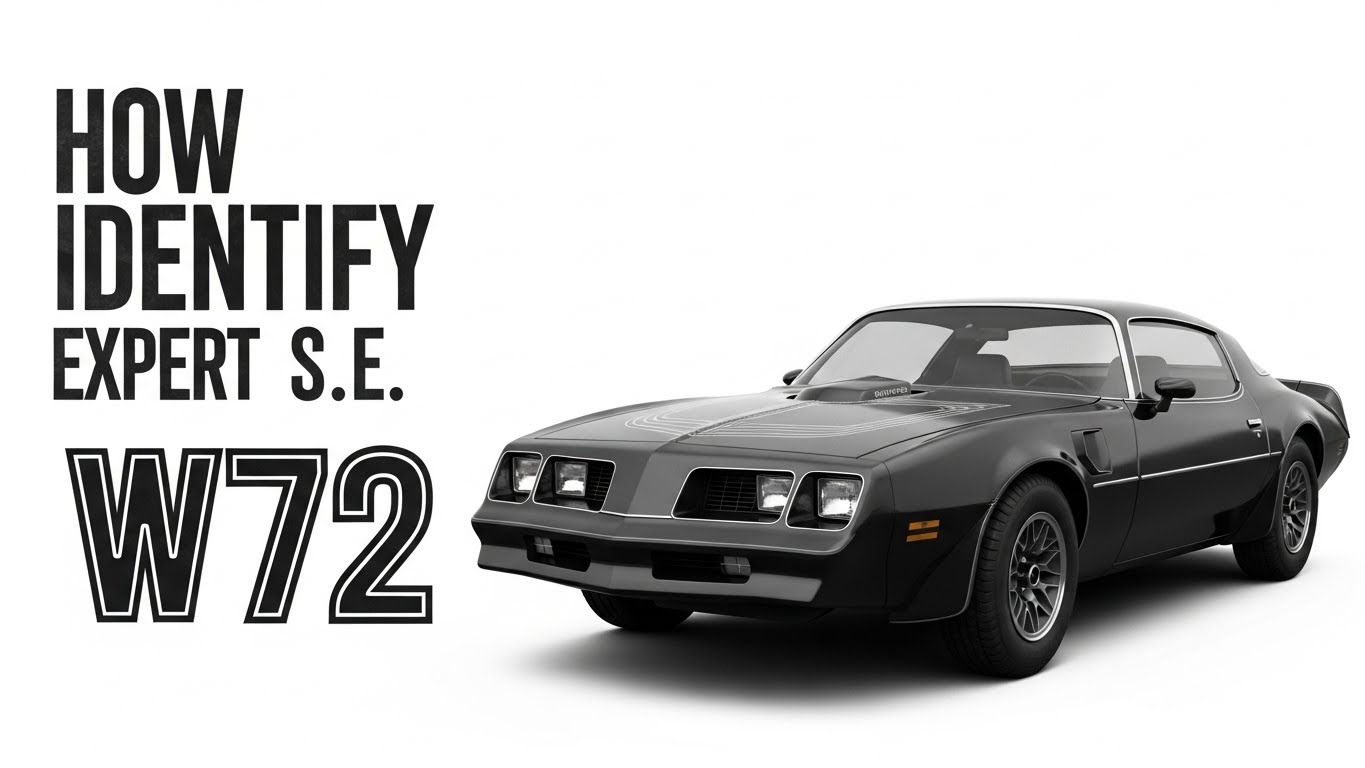
Imagine you’re walking into a dusty barn in the middle of nowhere. You pull back a heavy, old tarp, and there it is—a black 1977 Pontiac Trans Am. The gold “Screaming Chicken” on the hood is staring right at you. Your heart starts racing. Is this the real deal? Is this the car Burt Reynolds made famous in Smokey and the Bandit? Or is it just a regular Trans Am that someone painted black ten years ago?
The difference between a real Special Edition (S.E.) with the high-performance W72 engine and a “tribute” car can be fifty thousand dollars. Maybe more. You don’t want to be the person who overpays for a fake. That’s why learning how to identify 1977 trans am s.e. w72 is the most important skill you can have as a classic car collector.
In this guide, we aren’t just going to look at the paint. We’re going to look at the “bones” of the car. We’ll check the numbers, crawl under the engine, and look at the paperwork. By the end of this, you’ll know exactly how to identify 1977 trans am s.e. w72 like a professional appraiser.
Step 1: Start with the VIN (The Car’s Fingerprint)
The first thing you should do—before you even look at the shiny gold wheels—is check the VIN (Vehicle Identification Number). You’ll find it on a small metal plate on the driver’s side dash, visible through the windshield.
If you want to know how to identify 1977 trans am s.e. w72, you have to become a code breaker. The VIN for a 1977 Trans Am starts with “2W87.”
- 2: Pontiac
- W: Trans Am
- 87: Sport Coupe
But the real magic is in the fifth digit. If the car has the 400 cubic inch engine (which all W72 cars do), the fifth digit must be a “Z.” If you see a “K” in that spot, it means the car came with an Oldsmobile 403 engine. You can stop right there—a 403 Olds engine was never a W72.
Knowing how to identify 1977 trans am s.e. w72 through the VIN is the fastest way to weed out the cars that were originally built as something else. If the VIN doesn’t have that “Z,” it’s not the car you’re looking for.
Step 2: Cracking the Cowl Tag Code
Once the VIN checks out, pop the hood. Look at the fire wall on the passenger side. You’ll see a small silver plate called the Cowl Tag or Trim Tag. This tag tells you how the car was dressed when it left the factory.
For the 1977 model year, the Special Edition package had two main codes. If the car has Hurst T-Tops (the small ones), the tag should say “Y82.” If the car is a “Hardtop” (no T-Tops), it should say “Y81.”
This is a vital step in how to identify 1977 trans am s.e. w72. Many people take a standard black Trans Am and add gold decals later. But they usually don’t change the Cowl Tag. If the tag doesn’t say Y81 or Y82, it’s not a factory Special Edition. It might be a nice car, but it’s not the “Bandit” S.E. that collectors want.
Step 3: Finding the W72 Engine Stamps
Now we get to the heart of the beast. The W72 was a special “High Output” version of the 400 V8. In 1977, while most cars were getting slower and weaker, Pontiac decided to give the fans one last roar. They added a better camshaft, a high-capacity oil pump, and specific heads to create the W72.
To master how to identify 1977 trans am s.e. w72, you need a flashlight and maybe some degreaser. Look at the front of the engine block on the passenger side, just below where the head meets the block. You’re looking for a two-letter code.
- If the car has a manual transmission, the code should be “WA.”
- If the car has an automatic transmission, the code should be “YA.”
If you see these letters, you’ve likely found a real W72 block. This is the “meat” of the car’s value. When people ask me how to identify 1977 trans am s.e. w72, I always tell them to look for that “WA” or “YA” stamp first. Everything else can be replaced, but the original block is what matters.
Step 4: The 6X-4 Head Myth
While you’re looking at the engine, look at the “heads” (the parts on top of the block). There is a small flat spot on the side of the head where a code is cast. For a real W72, you want to see “6X” stamped on the top, and if you look closely at a small boss on the side, you’ll see a “4.”
Standard 400 engines had “6X-8” heads. The “6X-4” heads were used on the W72 and the 350 engines because they had smaller combustion chambers, which gave the car more compression and more power.
Learning how to identify 1977 trans am s.e. w72 means knowing these small details. A fake car will often have the 6X-8 heads because they’re easier to find. If you see “6X-4,” you’re looking at the high-performance parts that made this car a legend on the street.
Step 5: The “T/A 6.6” Decal vs. “6.6 Litre”
If you look at the hood scoop (the shaker), you’ll see a decal. This is a tiny detail, but it’s a huge clue when you’re learning how to identify 1977 trans am s.e. w72.
In 1977, Pontiac used two different decals for their 400 engines:
- “6.6 Litre”: This was for the standard L78 400 engine.
- “T/A 6.6”: This was reserved specifically for the high-output W72 engine.
If you see “6.6 Litre” on a black and gold car, it might be a real S.E., but it’s probably not a W72. Of course, anyone can buy a $20 decal and stick it on a shaker, so don’t trust the decal alone. Use it as a hint, then verify with the engine codes we talked about earlier. This is a common shortcut people take, so don’t let a simple sticker fool you while you’re trying to figure out how to identify 1977 trans am s.e. w72.
Step 6: Gold, Gold, and More Gold
The Special Edition wasn’t just a paint job; it was a theme. If you want to know how to identify 1977 trans am s.e. w72, you have to look at the trim.
The S.E. cars came with gold pinstriping that was actually applied over the paint. You should be able to feel the edge of the stripe with your fingernail. They also featured a gold-colored “dash bezel” (the metal plate around the gauges). This plate had a “swirled” or “engine-turned” finish. On a real S.E., that swirl should be gold, not silver.
Also, look at the steering wheel. The spokes should be gold. The horn button should have a gold bird. Even the “Snowflake” wheels (or Honeycomb wheels early in the year) should have gold accents in the recessed areas. When you combine all these gold touches, you start to see the full picture of how to identify 1977 trans am s.e. w72.
Step 7: The Hurst T-Top Trap
Most people think every Bandit car had T-Tops. That’s not true! In fact, the very first 1977 S.E. cars were hardtops. But the T-Top version is the one everyone wants.
In 1977, Pontiac used Hurst T-Tops. These are often called “Slim Jims” because they are much smaller than the Fisher T-Tops used in later years. The Hurst tops have a thick weatherstrip and a large chrome handle.
If you’re learning how to identify 1977 trans am s.e. w72, check the T-Tops carefully. If they look too big or the glass goes almost to the edge of the roof, they might be Fisher tops from a later year that someone grafted onto a 1977 body. A real 1977 Y82 will always have those smaller Hurst tops.
Step 8: Don’t Forget the Interior
The interior of a 1977 S.E. W72 was a nice place to be. Most of them came with black “Deluxe” interiors. You’ll see a specific pattern on the seats and door panels.
One thing people often miss when they try to learn how to identify 1977 trans am s.e. w72 is the console. The gear shift plate should match that gold engine-turned finish from the dash. If the dash is gold but the shifter plate is silver, someone likely put the car together from a parts bin. Consistency is key when you’re looking at an original survivor.
Step 9: Use PHS (Pontiac Historical Services)
I’m going to let you in on the biggest secret in the Pontiac world. You can do all the detective work you want, but there’s only one way to be 100% sure. You need the PHS documents.
A man named Jim Mattison, who used to work for Pontiac, saved the factory shipping records for almost every Pontiac built. For a small fee, you can send them your VIN, and they will send you a copy of the original dealer invoice.
If you’re serious about how to identify 1977 trans am s.e. w72, this is your gold standard. The invoice will list “Y82” (or Y81) and “W72” right there in black and white. If a seller says they have a real S.E. W72 but they won’t show you the PHS papers, walk away. Every real owner knows that PHS is the “birth certificate” for these cars.
Why the W72 is Worth the Extra Money
You might be wondering, “Why go through all this trouble? Is the W72 really that much better?”
In short: Yes. In 1977, the standard 400 engine only made 180 horsepower. That’s not much for a big, heavy car. But the W72 was rated at 200 horsepower (and many people think Pontiac lied and it was actually closer to 220 or 230).
It had more torque, a better throttle response, and it just sounded meaner. It was the only engine that really lived up to the “Trans Am” name that year. When you learn how to identify 1977 trans am s.e. w72, you aren’t just buying a car; you’re buying the last gasp of true American muscle from the 70s.
Common Red Flags to Watch For
While you’re out there in the field, keep your eyes open for these “uh-oh” moments:
- Spray-painted dashes: If the gold on the dash looks uneven or bubbly, someone might have used a rattle can to “make” it an S.E.
- Missing VIN rivets: If the VIN plate looks like it’s been moved or has new rivets, someone might be trying to swap a clean VIN onto a junk car.
- The “Bandit” name: Remember, Pontiac never actually called the car a “Bandit Edition” in 1977. They called it the “Special Edition.” If a seller keeps calling it a “Factory Bandit,” they might not know much about how to identify 1977 trans am s.e. w72.
My Real-World Example: The “Fake” I Almost Bought
Years ago, I found a 1977 Trans Am for a great price. It looked perfect. It had the gold pinstripes, the gold dash, and the “T/A 6.6” on the shaker. I was ready to count out the cash.
But then I checked the fifth digit of the VIN. It was an “L.” An “L” code meant it was a 350 cubic inch engine originally. The owner had swapped in a 400 and painted it black. It was a “clone.”
Because I knew how to identify 1977 trans am s.e. w72, I saved myself about $20,000. That’s why these codes are so important. They protect your bank account.
Is it Still Worth Buying if it’s a “Clone”?
There is nothing wrong with buying a clone if you just want a fun car to drive. Clones look great, and they’re often built better than the originals. But you should pay “clone prices,” not “S.E. prices.”
When you know how to identify 1977 trans am s.e. w72, you can negotiate with confidence. You can say, “Look, I know this isn’t a factory W72, so I’m not going to pay the premium.” It puts you in the driver’s seat of the deal.
Final Thoughts: The Thrill of the Find
Finding a real-deal Y82 W72 is like finding a needle in a haystack. Only about 3,700 of the Hurst T-top W72 cars were made in 1977. Many of them were crashed, rusted out, or stripped for parts over the last 40 years.
But they are out there. And now that you know how to identify 1977 trans am s.e. w72, you have the tools to find one. Check the VIN for that “Z.” Check the Cowl Tag for “Y82.” Crawl under the front and look for that “WA” or “YA.”
The hunt is the best part. There’s nothing like the feeling of verifying a real piece of history. So get your flashlight, get your degreaser, and start looking. That black and gold bird is waiting for you somewhere.
Read More: https://acurasportscar.com